A morning with Ernesto
(ONE OF A
SERIES
)
Before leaving Managua for our home in Vermont, we spend a last morning with Ernesto Cardenal.
We have fond memories of our visit with him in 1988 when we were first in
Nicaragua, and we have been looking foward to seeing him again.
At that time, Ernesto was the Minister of Culture, and one of the few Catholic
priests who held government offices after the Revolution. He was vigorously
promoting the national literacy program and a variety of cultural opportunities
in music and the arts for young people.
|
This time we meet with Ernesto in his art studio in Managua, where there are
lovely examples of his sculptures and paintings on display.
At first glance, he seems much as he did when we first met him 12 years ago:
Flowing white hair and beard, black beret, white shirt, gentle smile, and
youthful spirit. But there is an air of sadness
about him.
|
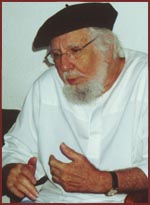
Ernesto Cardenal
|
The morning visit passes quickly with many questions. What really brought
about the collapse of the Sandinista Revolution? What happened to the persons
whose hopes and lives were invested in that cause? What is it like to live in
Nicaragua now? What of the future?
We hear once again of the brutal divisiveness of the Contra War.
We hear of the people traumatized by the killings, worn out by poverty and
strife.
But at the end, the saddest story of all: the sense of betrayal by the very
colleagues who had served in leadership positions in the Revolution.
When it was clear that the administration had to yield to popular elections,
some of the top leadership of the Sandinista Party did the very things that
they had accused their predecessors of doing, amassing wealth and property for
their own personal and private aggrandizement.
The disillusionment continues to the present day. As we meet, they are preparing for new elections. Ernesto speaks of
el pacto, the deal that Daniel Ortega, former president and head of the Sandinista
Party, has made with the present president, Arnoldo Aleman.
With a vastly unpopular Constitutional amendment and the consent of Congress,
both Ortega and Aleman have been granted lifetime membership in the Senate. They
thus obtained immunity from prosecution, which they both needed because of
lawsuits brought against them.
At the same time they have assured the position of their political parties by
requiring an impossible number of signatures for the recognition of new parties
in the political system. And they both affirm that salvation lies with "free
trade." [learn more]
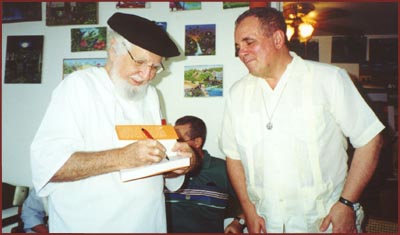
Ernesto Cardenal and Brother Richard
Ernesto has deeply loved the monastic movement since his youth, when besides
trying to resist the repressive police state of the U.S.-imposed Somoza
dictatorship, he dreamed of becoming a monk.
He spent some time in Gethsemani Abbey in Kentucky, where he became a friend of
Thomas Merton, but the North American winter proved a health hazard for this
son of the tropics.
He then went to the Benedictine Monastery of Santa Maria de la Resurreccion in
Cuernavaca, Mexico, but that monastery was closed and the community disbanded.
Back in Nicaragua, he started a lay community in the
Solentiname Archipelago, where gospel values were to inform the life of these
peasants and fishing folk.
Under Ernesto's guidance, spirituality and the arts flourished in the
community, but war and the Revolution brought this new attempt at
gospel-based community life to an end.
Today the Revolution itself is gone, some of the former Sandinista leaders are mired in scandals, and he himself has resigned from the Sandinista Party.
The country is in far worse shape than it was in the '80s. Although the war,
the American blockade and the embargo are over and the Somozas are gone, the
present government is the most corrupt in the history of Nicaragua.
Ernesto explains this situation in grim detail, yet he remains hopeful.
Hope? Amidst the pandemic misery, unemployment, lack of education and health
care for the vast majority? Amidst the drugs, violence and suicide among the
young? Such hope is, in itself, an act of defiance and rebellion.
Ernesto is now engaged in writing the second volume of his autobiography,
Una Vida Perdida
-- A Lost Life. It doesn't sound like a very cheerful or hopeful title, and
yet it is based on his real life experience in the light of the gospel saying,
"Those who lose
their life will find it!"
It is the story of life becoming the gift of self for others, the life journey
so vividly traced out by Jesus of Nazareth. It is a story of radical joy.
In La Mañanita, he has written of the vision of faith rising from the
ashes of the Nicaraguan experience:
All this was here before
But a dark night covered it,
And it could not be seen. The night of temptations.
Each one with his own temptation.
The temptation of a false dawn that still could not be.
Lying in bed in the middle of the night, dreaming it's already dawn.
Now yes, dawn is here, Pancho Nicaragua,
Everything is clear
Around this shanty.
Land and water. You can see it.
And in that hut I hear someone sing:
"How joyous and fresh
is the morning."
It's the midnight dream of Ernesto Cardenal, of the poor, of the little ones of
Nicaragua, dreaming when Easter resurrection will finally dawn in
Nicaraguita
, Little Nicaragua!
A popular Nicaraguan song goes like this:
"Ay Nicaragua, Nicaraguita, la flor mas Linda de mi querer!"
--Oh Nicaragua, little Nicaragua, the most beautiful flower of my longing!
We will return to Vermont knowing that the loving mystery of God has been
disclosed to us in this beautiful flower, Nicaragua -- in its fragile grace and color, in
its aching misery and poverty.
In the words of the Little Prince, "It is only
with the heart that one can see rightly; what is essential is invisible to the
eye."
Next:
Looking back from Vermont
Back to Top
58 Priory Hill Road • Weston, VT 05161-6400 •
802-824-5409 • Fax 802-824-3573
Prayer Schedule |
Bulletin |
Retreats |
Our Life & Values |
Living With a Monastic Community
Becoming a Brother |
Directions |
Online Shopping |
Articles |
Links |
Home
© The Benedictine Foundation of the State of Vermont, Inc. All Rights Reserved