Remembering Managua, 1988:
A factory, a settlement, a prison
(ONE OF A
SERIES)
JANUARY 1988 (continued): A visit to a clothing factory in Managua gives us the
opportunity to meet people involved in the economic sector of the country. The factory building is
located on one of the unpaved side streets of the capital city. It appears to
have been an active factory some years before, and it is our understanding that
the original owners fled the country, abandoning the facility.
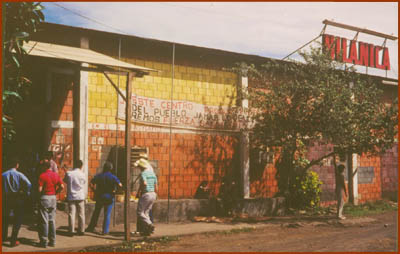
Exterior, worker-owned clothing factory in Managua
Inside, there is the hum of sewing machines and a maze of workstations occupied
by women dressed in pink smocks. A man and woman, both supervisors, welcome
us. Before we begin to tour the factory and mingle with the workers, the
supervisors explain that the people who work here own this factory. They speak
of the enthusiasm of the workers and their pride in being responsible for what
they produce, as well as in this opportunity to bring income to their families.
The workers, and therefore the owners, are predominantly women.
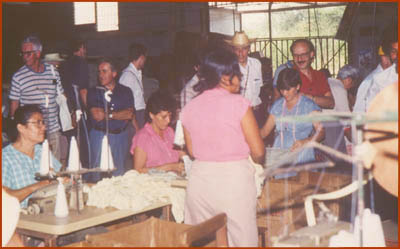
Owners at work in their clothing factory
As we walk around the factory floor, the women look up and smile, and some stop
to chat with us. Even though the equipment in the factory seems quite ancient,
the reflections of the women are positive about being more in control of their
own lives, about the hours they work, the spirit of cooperation, and the
sharing in decision-making and ownership.
The supervisors point out that the
equipment frequently breaks down because of its age, and that it is extremely
difficult to repair. With the blockade of the harbor, it is impossible to
obtain parts that can be found only in the United States or overseas. The
purchase of yarns and threads is likewise difficult.
After a lengthy morning visit, we are invited to join the workers for lunch.
Everyone sits in groups at picnic tables and there is relaxing conversation.
Brothers offer to sing a few songs before the lunch is ended and are greeted
with enthusiastic appreciation.
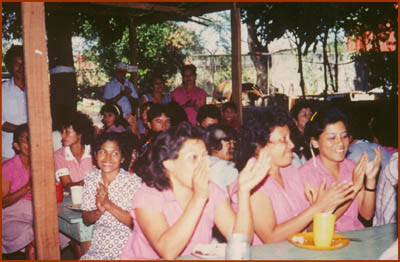
Worker-owners enjoying lunch and songs
Leaving the factory, we realize that we have experienced but one tiny glimpse
of hope in an area of life that is much more complex and challenging.
The settlement
Speaking with the ordinary poor people is another important learning
experience. On the outskirts of Managua, still in the low plains area before
the foothills and high mountains, we arrive at a settlement of poor little
shacks that seem newly constructed. At first glance it appears to be a
squatters' settlement, but we learn that it is part of the effort of the
government to resettle people who have lost their homes in the earthquake.
At the door of one of the little dwellings a woman, perhaps in her mid-50s,
waves a greeting to us. We stop to chat. We are welcomed into her home. It
is one room constructed of poles enclosed by cardboard and plastic, and with a
corrugated tin roof.
Inside: a bed, a few crates to serve as table and chairs
and a one-burner cooking stove. She is happy to tell her story -- to tell that
now she owns a home of her own. She displays a document and explains that she
has legal title to this little parcel of land.
"I can read now, and I know my
rights!" A simple declaration expressed with such dignity. Her story, while
personal and uniquely her own, resembles the stories of others we have heard in
this difficult country. It is a story of abandonment, poverty, and abuse. But
it is also a story of courage, hope and dignity.
The prison
A short drive further outside the city brings us to an "open prison." From the
approach, it looks much like an ordinary farm. The road and fields are neat
and well tended. A tall, friendly black man in uniform meets us. He is the
principal guard and manager of the prison. While guiding us around the prison
property, he speaks of his own satisfaction in working in this kind of
institution. Part of his work is to help the prisoners build a sense of
responsibility in the operation of the farm. Learning work skills and
organizing among themselves gives the prisoners a sense of their own dignity
and self-respect.
When we are introduced to a group of men feeding the animals, one of them tells
us that he was previously a prisoner and that he found the experience so
valuable that he applied to come and work at the farm after his release. The
exchange between prisoners and guard is remarkable for its sense of mutual
respect.
Next:
Some experiences of the journey:
The churches
Back to Top
58 Priory Hill Road • Weston, VT 05161-6400 •
802-824-5409 • Fax 802-824-3573
Prayer Schedule |
Bulletin |
Retreats |
Our Life & Values |
Living With a Monastic Community
Becoming a Brother |
Directions |
Online Shopping |
Articles |
Links |
Home
© The Benedictine Foundation of the State of Vermont, Inc. All Rights Reserved